Office cleaning a company can actually plan around
The problem with office cleaning is rarely the cleaning. It is a different person every week, a key nobody can find, and no one on site who knows the alarm code.
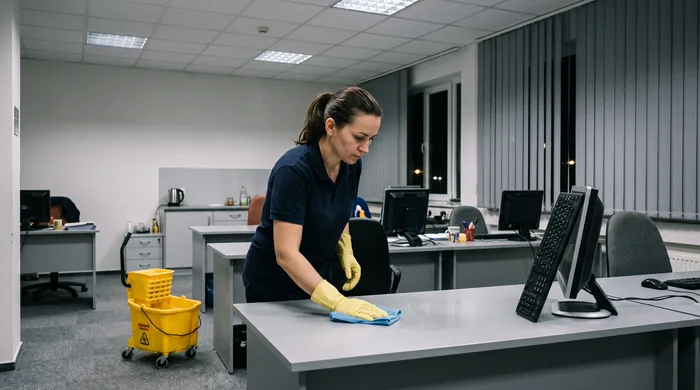
A rotating team costs more than it saves
Every new cleaner in an office spends the first three visits working out where things are and what not to touch. Where the team rotates, that first visit never ends. The bin under the far desk that is always missed, the meeting room cleaned only when it happens to be empty, the kitchen tap nobody has descaled since the company moved in: none of those are effort problems. They are memory problems.
The same two people every week solves most of it without anyone having to write a procedure.
What a weekly contract covers
- Desks wiped where they are clear, cups taken away, papers left alone
- Bins emptied and the recycling actually kept separate
- Kitchen: sink, worktops, the outside of the fridge, the inside of the microwave
- Toilets, with consumables restocked from your stock or ours
- Meeting rooms reset, chairs in, whiteboard cleaned unless it is marked otherwise
- Floors vacuumed and hard floors mopped
- Glass doors and partitions, where the handprints are
What sits outside the weekly visit
- Carpet extraction and the upholstery on office chairs, twice a year in an office of any size
- Windows and glazed frontage, quarterly
- Inside the fridge, which needs a date and a warning email rather than a surprise
- Cleaning after a renovation or a fit-out
- Server rooms and locked areas, unless written into the contract with an access rule of their own
Out of hours is the default
We work after six in the evening or before eight in the morning, because a vacuum running through a call costs more than the clean is worth. That means access, and access means one of three arrangements: a key we hold and sign for, a code that is yours to change when someone leaves, or a member of your staff who lets us in and locks up. Whichever you pick, the same named people come and you know who they are.
Consumables are where contracts go sour
Paper, soap, bin bags and hand towels are small money and the most common argument in office cleaning. Somebody runs out on a Thursday, nobody is sure whose job it was, and the cleaner gets blamed for a purchasing gap.
Pick one of the two arrangements at the start and write it down. Either you stock a cupboard and we restock from it and tell you when it is running low, or we supply and the cost appears as its own line on the invoice. What does not work is leaving it unsaid, which is how an office ends up buying paper twice in a month and blaming the cleaning bill for it.
What you get on paper
An invoice a Hungarian company can put through its books, issued monthly. A photo report after each visit, which matters most in offices where the person paying the invoice is never in the building. And a named contact who answers, so that the reply to a cleaning problem is not an inbox saying somebody will look into it.
What sets the price
Square metres, the number of workstations, how many toilets, and how often we come. Two hundred square metres with twenty desks and two toilets is a different job from two hundred square metres of open plan with four people in it, and floor area on its own will get you the wrong number. We walk the space before quoting. It takes twenty minutes and it saves the renegotiation three months in.
Common questions
Can we start with a trial?
One month on the same terms, notice on either side. Nobody should sign a year for a service they have not seen.
What happens when our cleaner is ill?
Somebody else comes, and you are told before the visit rather than after. That is the one week the routine breaks, and it is better said out loud.
Do you cover retail units and clinics?
Yes. Clinics have their own requirements for surfaces and waste, and those go into the contract explicitly instead of being assumed.
Book a walk-through
Twenty minutes on site, and you get a monthly price, a schedule, and the names of the people who will come.
Get a quote