What not to do to a stained sofa
Most of the sofas we cannot fully rescue were not ruined by the spill. They were ruined in the twenty minutes after it.
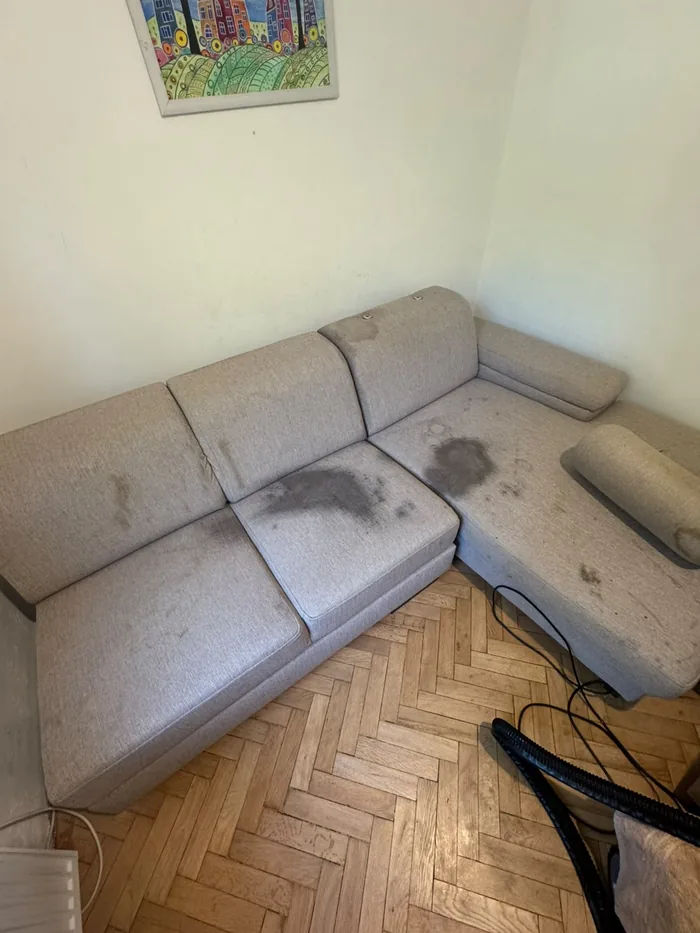
The foam does not leave when the stain does
A supermarket upholstery cleaner, Vanish and everything shaped like it, works by putting detergent into the fabric. On a shirt that is fine, because the washing machine then rinses it out. A sofa has no rinse cycle. The detergent stays in the fibre after the mark has gone.
Detergent left in fabric is sticky, and sticky fabric collects dust faster than the fabric around it. This is why a patch that looked perfect on Sunday is a visible grey shadow three weeks later, in exactly the shape of the area that was treated. The stain did not come back. The soap is catching dirt.
It is also why we ask on the phone whether anything has been used already. It changes the job: the residue has to be pulled out before anything else can be done, and that takes longer than the original stain would have.
Why the mark comes back bigger the next day
Upholstery is fabric stretched over foam. Liquid does not sit on the surface, it sinks into the foam and spreads sideways, carrying dissolved dirt with it. As it dries, it travels back up the fibres and deposits that dirt at the top, at the edge of the wet area.
The result is a ring wider than the original spill, often darker at the rim than in the middle. Cleaners call it wicking. Pouring more water on it makes the ring wider still.
An extraction machine avoids this because it puts water in under pressure and pulls it straight back out in the same pass. The foam never gets soaked, so there is nothing left to travel back up.
Rubbing costs more than the stain does
Blotting lifts. Rubbing grinds. On velvet, chenille and microfibre it flattens the pile, and flattened pile catches light differently from the pile around it. That patch stays visible after the stain is completely gone, and no cleaning brings it back, because nothing is dirty. The fibres are bent.
Press a white cloth down, hold it, lift it, move to a clean part of the cloth, repeat. White matters: a coloured towel can hand its own dye to damp fabric.
Work from the outside of the mark inwards. Starting in the middle pushes the edge outward and makes the stain bigger than it was.
The letter on the label decides everything
Almost every sofa has a care tag under a cushion or beneath the frame with a single letter on it, and it is the difference between a stain and a repair.
W means water-based cleaning is safe. S means solvent only, and water will leave a permanent ring on it whatever you do afterwards. WS accepts either. X means neither: vacuum only, and anything wet will mark it.
If the tag is gone, assume S until proven otherwise. Photograph the tag and send it with the photo of the stain, it tells us in one glance what is possible.
Heat is the one mistake that cannot be undone
Blood, milk, egg, sweat and most food spills are protein. Hot water sets protein into fibre the way it sets an egg white in a pan, and once it is set no chemistry removes it. Cold water only, always, on anything biological.
The same goes for the hairdryer people reach for to speed up drying: it cooks whatever is still in the fabric. Open a window instead.
Pet urine is its own case. The stain is easy; the smell is not, because it is in the foam rather than the fabric, and it returns on humid days long after the mark has gone. That needs an enzyme treatment, and it is worth saying on the phone rather than after we arrive.
The first four minutes matter more than the product
Almost everything comes out while it is still wet. The same spill twenty-four hours later is a different job, and a week later it may be permanent, particularly red wine, coffee and anything with turmeric.
So: lift what is solid with a spoon rather than a cloth. Blot with white cotton, cold, from the outside in. Do not add soap, do not add heat, do not rub. Then photograph it and decide.
That is not us being precious about our own trade. Nine out of ten stains we cannot fully lift had something applied to them first.
Common questions
I already used Vanish. Is it too late?
No, but say so when you write to us. The detergent has to be flushed out before anything else works, which adds time; hiding it just means we find out on site.
Will the stain definitely come out?
Spills, marks from a previous tenant and general wear usually do. Old dye, ink, bleach damage and anything already set with heat often do not. We tell you which one we think it is from the photo, before booking, not after.
How long does a sofa take to dry?
Four to six hours with the windows open, longer for heavy fabric. Do not sit on it or cover it while it is damp.
Do you clean both sides of a mattress?
One side is the standard. Both sides is possible and costs more, and it means the mattress cannot be slept on that night.
Send a photo of the stain
Tell us what it is and whether anything has been used on it. We reply with a price and an honest answer about what will come out, within two hours.
Get a quote